If you’ve spent any time on LinkedIn, you already know what I’m talking about. The endless stream of “excited to announce” posts, generic listicles, and jargon-filled whitepapers that sound like they were written by a committee of buzzword generators.
It’s not just you — most B2B content really is boring.
But that’s great news for you. Because when the bar is set so low, you don’t need to be a genius copywriter or a viral content machine to stand out. You just need to avoid the mistakes everyone else is making — and add a little humanity back into your marketing.
So what exactly makes most B2B content such a snoozefest? It usually comes down to three repeat offenders — patterns that show up again and again in blog posts, LinkedIn updates, and “thought leadership” pieces.
The majority of posts start with “We’re excited to announce…” or “Our revolutionary new product…” Notice the common thread?
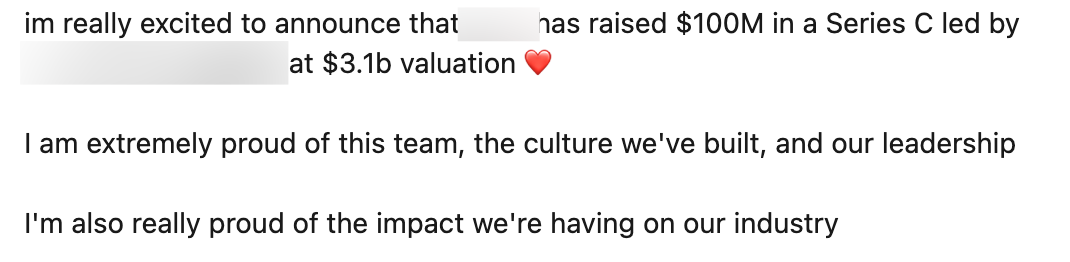
It’s all about them. Buyers don’t care about your internal milestones — they care about their 3 a.m. stressors and the fires they’re putting out at work.
Too many companies treat B2B buyers like robots who only respond to charts and ROI stats. But behind every “decision-maker” is a human being with fears, frustrations, goals, and dreams.
If your content has the emotional depth of a press release, don’t be surprised when nobody engages with it.
Tips, tricks, and features are thrown around like confetti, with no story, no flow, no connection to a bigger journey.
Buyers don’t want “content for content’s sake.” They want a guide who understands where they’ve been, where they are now, and where they want to go.
Still not convinced that most B2B content is underperforming? Let’s look at the numbers:
Translation: the majority of B2B content is noise that buyers scroll past without a second thought.
Here’s the silver lining: because everyone else is still pumping out robotic, ego-driven garbage, you don’t need to do much to win.
A few small shifts — adding emotional depth, focusing on your audience’s actual struggles, and structuring your content around a clear system — will instantly set you apart.
Think of it like walking into a networking event where 99% of people are handing out business cards and bragging about themselves. All you need to do is ask one thoughtful question, and suddenly you’re the most interesting person in the room.
That’s what smart B2B content does.
Most guides on “B2B content marketing” give you vague advice, a few overused buzzwords, and a diagram with a funnel on it. That’s not a system. It’s a low-effort attempt to rank for a few keywords.
What you actually need is a framework that helps you:
That’s where my six-step content system comes in.
It’s not a shiny new theory pulled out of thin air. It’s a mashup of two proven frameworks — Park Howell’s Story Cycle and Rob Lennon’s FFGA method (Fears, Frustrations, Goals, Aspirations) — re-engineered specifically for B2B.
Why? Because while most B2B marketers stick to “just the facts,” real decision-makers buy with a mix of logic and emotion.
Think of it like this: the Story Cycle gives your content narrative momentum, while FFGA injects the raw human psychology that makes your messaging actually resonate. Together, they form a system that turns bland “corporate speak” into stories that make your audience say: “Holy sht, this person gets me.”
Here’s a quick snapshot of how the six steps flow:
In the sections ahead, we’ll unpack each step in detail with templates, tools, and real-world examples so you can start applying this system immediately.
Most marketers stop at the shallow end of audience research. They know the job title, company size, maybe a few demographic details — and then they wonder why their content falls flat.
Your customers are not their LinkedIn headlines.
The “VP of Marketing” who looks polished and confident online might secretly think, “I have no idea if any of this is actually working.”
The “CEO” might describe themselves as “scrappy founder just trying to keep payroll covered.”
If you only focus on surface-level demographics, you’ll miss the messy, human side that actually drives decisions.
You don’t need a research team or a six-figure budget. Here are three scrappy, repeatable methods that will give you insights fast:
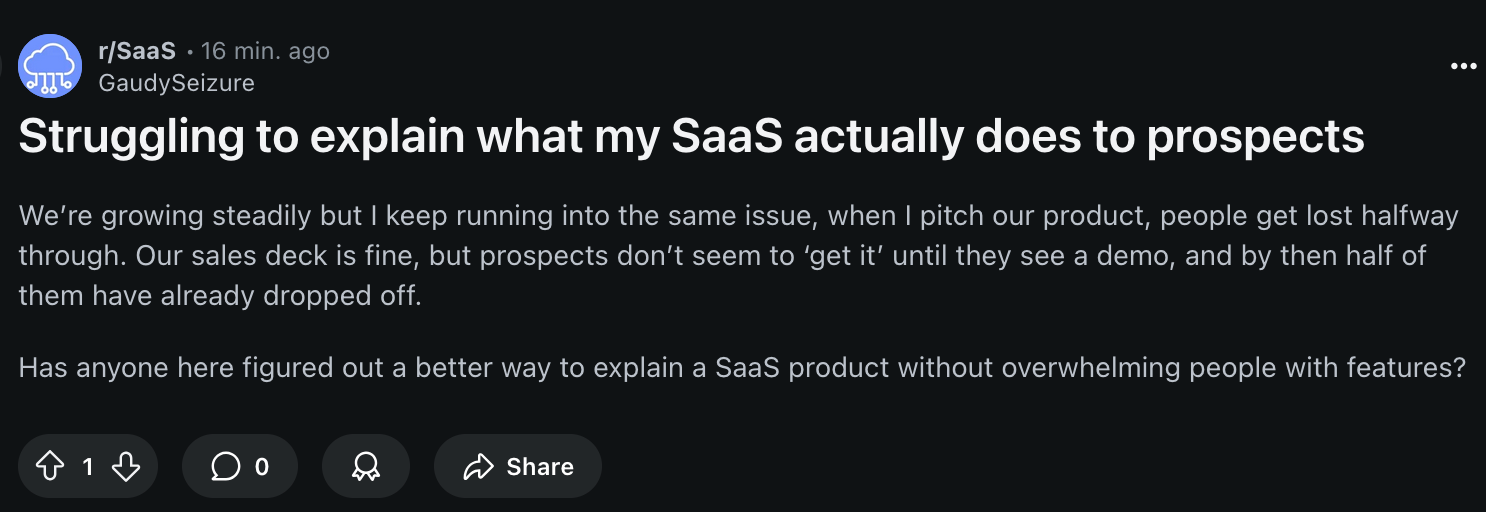
Here’s a script you can use tomorrow:
Pro tip: Don’t just listen to the answers — listen to the language. Exact words and phrases from your audience should show up in your content.
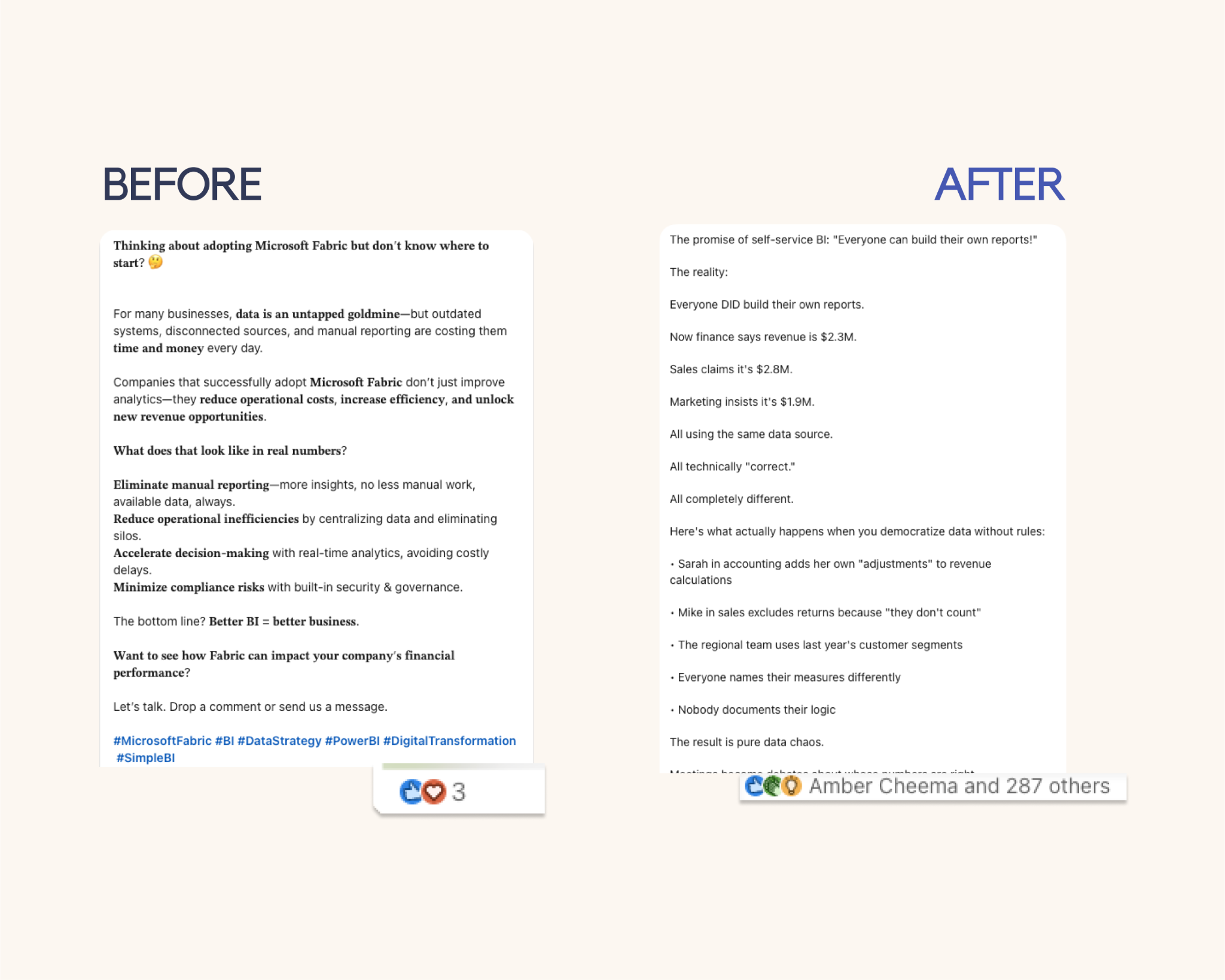
Let’s say you’re targeting startup founders. Here’s what surface-level vs. deep audience research looks like:
Now imagine the difference in content those two perspectives create:
By the end of this week, talk to 5 real humans in your target audience. Take notes on how they describe themselves, their frustrations, and their goals. Use their exact words to fuel your content.
This is the foundation of the system — skip it, and everything else collapses. Nail it, and you’ll have messaging that makes people stop mid-scroll and say: “Wow, this person gets me.”
If Step 1 is about knowing who your audience really is, Step 2 is about understanding what makes them tick. This is where we move beyond surface-level personas into the messy psychology that drives decision-making.
Because here’s the truth: people don’t buy products. They buy relief from fears, solutions to frustrations, progress toward goals, and validation of aspirations. Ignore these drivers, and your content becomes just another listicle. Lean into them, and your content feels like mind reading.
Most marketers assume B2B buyers only care about ROI and efficiency. But behavioral science says otherwise:
When your content reflects someone’s fears and aspirations back to them, it doesn’t feel like marketing — it feels like empathy.
You don’t need to guess. Here’s how to mine real insights:
Imagine you’re targeting startup founders:
The first appeals to metrics. The second appeals to identity. Guess which one gets bookmarked, shared, and remembered?
Use this table to map out your own audience insights:
Choose 5–10 people from your target audience and map out their FFGA. Don’t overcomplicate it — even a handful of conversations can reveal patterns that change your content strategy completely.
Once you’ve mapped fears, frustrations, goals, and aspirations, you’ll never look at “content planning” the same way again. You’ll have a cheat sheet for writing content that feels like you cracked open someone’s journal.
Here’s the marketing lie no one talks about: your buyers aren’t patiently waiting for your magical solution to show up in their feed. They’re stumbling through a chaotic maze of failed attempts, bad advice, and broken promises.
If you ignore that messy reality, your content will always feel generic — like you haven’t really been listening. But when you reflect their actual journey back to them, you build trust instantly. Because nothing says “I get you” like describing the exact struggles they’ve already lived through.
B2B buyers consume 3–5 pieces of content before engaging with a salesperson; ~3 in 10 consume more than 5.
I use a simple framework:
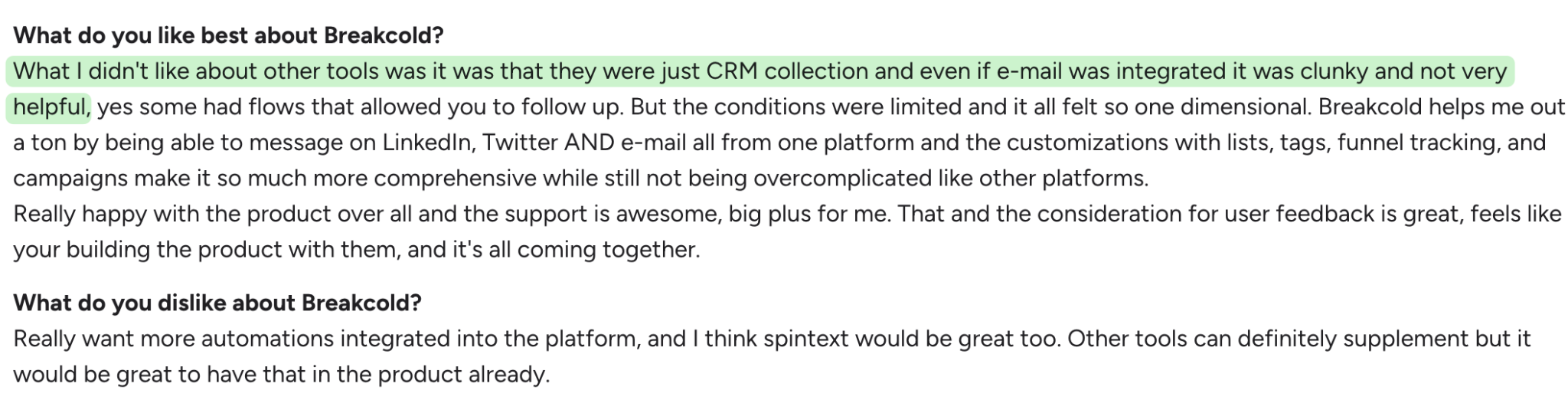
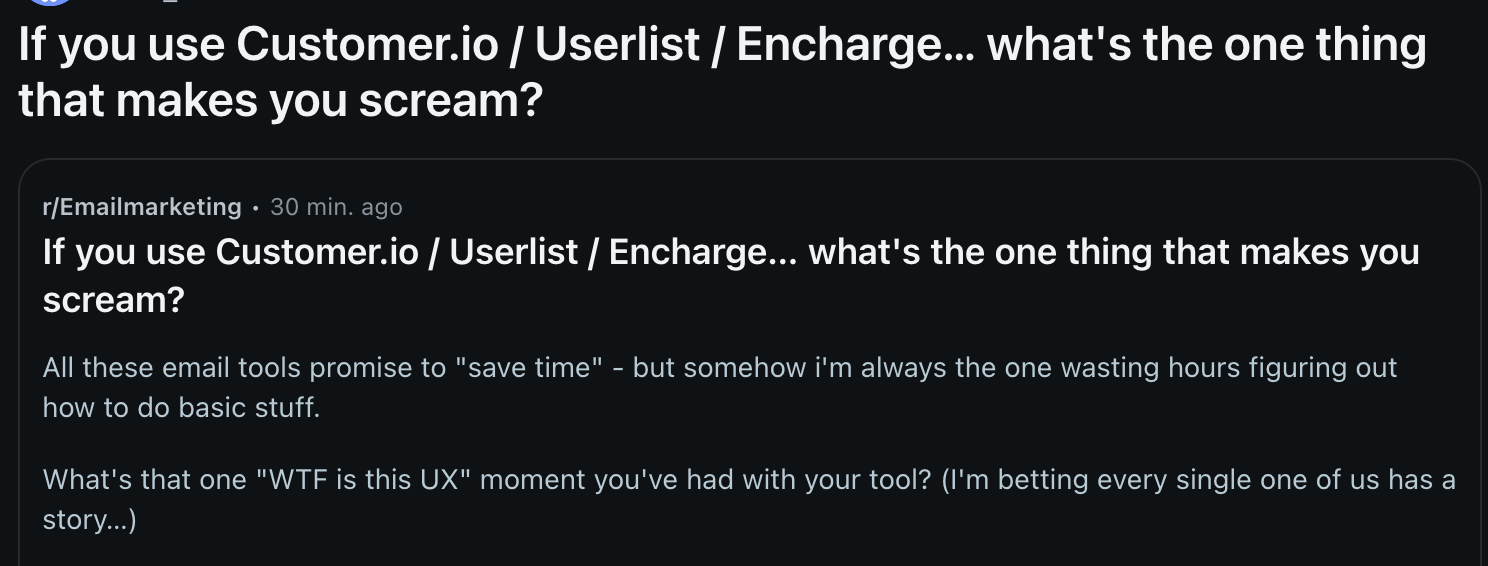
Once you’ve mapped the journey, you can create content that aligns with each stage. My rule of thumb: two strategic pieces per stage, per month. That’s six high-impact pieces of content that gently move buyers forward.
Notice how each piece mirrors the buyer’s internal story — past scars, present frustrations, future hopes. That’s what makes it resonate.
This week, interview at least 3 people from your audience and ask about their damage, struggle, and dream stages. Write down the exact phrases they use — then map two content pieces to each stage.
You’ll instantly have a mini content roadmap that’s 10x stronger than any “101 B2B tips” article floating around the internet.
Here’s why most B2B content gets ignored: it’s too damn safe.
It’s all sunshine and rainbows — “Here are 5 tips to improve X” — but it never tells readers what happens if they don’t act.
And that’s a problem, because psychology is clear: humans are twice as motivated to avoid pain as they are to pursue pleasure. If your content only shows the upside, you’re missing the real lever that drives action.
That’s where stakes come in. Stakes = the cost of doing nothing.
You don’t need to turn into a doomsday prophet. Stakes aren’t about scaring people for clicks — they’re about showing the real-world consequences of ignoring problems.
Here are three ways to source them:
Let’s compare two headlines:
See the difference? The first is forgettable. The second sparks FOMO and urgency.
Every B2B problem has stakes if you dig:
Notice how these aren’t abstract “challenges” — they’re quantifiable risks that feel very real.
Here’s the formula I use:
“If you don’t solve [problem] in [timeframe], you’ll lose [specific amount] in [specific way].”
Examples:
Pick one of your audience’s core problems and apply the stakes formula. Then, back it up with either:
Use that as the hook for your next piece of content. You’ll immediately notice the difference in urgency and engagement.
Every buyer has one. It’s not usually a slow build-up of frustration — it’s a breaking point.
A moment when they realize, “We can’t keep doing this. Something has to change.”
That’s the “Oh Sh*t” moment.
And here’s the secret: when your content reflects that moment back to them, it doesn’t feel like marketing. It feels like you’re inside their head, narrating their exact experience.
You can’t just ask, “When did you realize you needed us?” That question gets polite, surface-level answers. Instead, dig deeper:
The answers will almost always reveal an emotional trigger — the email, the call, the meeting that tipped them over the edge.
“Oh Sh*t” moments look different depending on the field:
Notice how each one is visceral — you can feel the stress in the moment.
Once you’ve identified these moments, you can spin them into stories that pull your audience in instantly.
Templates to try:
These aren’t just catchy headlines — they mirror the exact thoughts your buyers are having right now.
Interview three customers and ask them to describe the day they knew they needed to change. Capture the emotions, not just the facts. Then turn one of those moments into your next piece of content using the templates above.
This is how you stop sounding like a marketer and start sounding like someone who gets it.
You’ve exposed their fears, mapped their frustrations, raised the stakes, and nailed their “Oh Sh*t” moment. But here’s the thing: urgency alone won’t get someone across the finish line.
To actually move, people need hope. They need to see a future version of themselves where the struggle is over and success feels real. That’s where “winning moments” come in.
From my work with clients, I see three “victory checkpoints” that matter most:
Each stage offers rich material for content — blog posts, case studies, customer videos, even LinkedIn snippets.
Here’s how to turn those checkpoints into strategic content:
These stories not only showcase results but also allow prospects to imagine themselves achieving the same transformation.
Go back through your last 10 customer reviews, testimonials, or call notes. Highlight every phrase that signals relief, excitement, or transformation. Then, turn those exact words into your next piece of content.
When buyers see their own version of “winning” reflected back at them, they don’t just feel understood — they feel like the future you’re offering is actually possible.
Cool frameworks are nice. But unless they actually move the needle, they’re just another slide deck collecting dust.
So let’s talk about measurement. The goal isn’t just to rack up likes on LinkedIn — it’s to build a content system that predictably drives customers and revenue.
If the numbers aren’t where you want them, here’s how to troubleshoot:
Measurement isn’t a one-and-done deal. Every month, do three things:
Over time, you’ll refine your system into a machine that doesn’t just get clicks — it gets customers.
Pick one KPI from each bucket (engagement, conversion, pipeline) and set a baseline this month. In 90 days, review again. If you’ve followed the system, you should see:
At this point, you’ve got the bones of a content strategy that actually resonates. But if you stop here, you’ll only scratch the surface of what’s possible.
Scaling your system means doing two things:
Here are three advanced plays to take your content from “working” to “working on autopilot.”
Most marketers publish once and move on. Huge mistake. The best companies treat one strong piece of content as raw material for dozens of assets.
Here’s how to break down a single blog post or case study into multiple formats:
Pro tip: Create repurposing automations so nothing gets wasted.
Publishing is not the same as distributing. In B2B, distribution is where you win or lose.
Tactics to test:
Think of it this way: your content calendar is only as strong as your distribution plan.
AI won’t replace the system — but it can speed it up.
Ways to integrate AI without losing authenticity:
The golden rule: let AI do the heavy lifting on volume, but keep humans in charge of tone, stories, and stakes.
Take your last successful piece of content. This week, repurpose it into at least three new formats, and distribute them across different channels. Track performance to see which format-channel combo hits hardest.
Do this consistently, and your system won’t just create better content — it’ll create compound content that grows your reach without multiplying your workload.
Even with the right framework, it’s easy to fall back into bad habits. Here are the biggest mistakes I see teams make — and how to avoid them.
“I know my audience already.”
No, you don’t.
Assumptions are the #1 content killer. When you skip interviews, you default to clichés and generic advice that blends in with everyone else.
Fix: Commit to at least 5 conversations before building content. Always.
If you invent dramatic consequences without data, your audience will smell the BS instantly. Fear works — but only if it’s grounded in reality.
Fix: Back every “cost of inaction” statement with either a credible report (IBM, McKinsey, Deloitte) or a real customer story.
“The day I realized spreadsheets were slowing me down.”
Yawn.
If your disruption story could apply to literally anyone, it won’t hit. The power is in the specificity.
Fix: Anchor your story in real events — the email, the missed client deadline, the 3 a.m. panic attack.
No one cares that your tool has “advanced dashboards” or “AI automation.” They care about what that means for them: fewer headaches, more sleep, a promotion instead of a pink slip.
Fix: Rewrite every feature description into a “so what?” statement that ties back to FFGA.
Random blog posts, inconsistent LinkedIn activity, a case study here and there — that’s not a strategy. That’s noise.
Fix: Map content to the customer journey and publish consistently — even if it’s just once a week.
Don’t overthink it. Start small. This week, line up 5 audience interviews. Next week, map the FFGA. By the end of the month, you’ll have your first three high-impact content pieces live.
And if you want to shortcut the process? That’s what my team does — we build this system for B2B companies who are too busy (or too smart) to waste time on fluff.
👉 Book a call and let’s build you a content system that actually works:
Learn more about B2B Content Marketing: